Pages

Showing posts with label canine body language. Show all posts

Saturday, September 3, 2016

Doggie Outtakes; Whispering Dogs Part 2

This week, I want to see if you paid attention to the last post. It's like a little quiz, with pretty pictures of cute pups and a great sense of pride if you answer the questions correctly.
So, last week time (was it three weeks now or a full month?!) I wrote about how dogs have basically three levels of communicating: whispering, talking, and yelling.
Here's a recap of the things you want to look for at each level:


Whispering: lip lick, short stare, slight head turn, scratching frequently or out of context (like in the middle of play), sniffing the ground out of context (in the middle of play or when meeting someone), leaning away, looking away, low tail, yawning, moving slowly
Talking: hyper-vigilant (looking around quickly), excessive yawning, panting when it's not hot, freezing in position, moving away, "whale eye" (looking so far in one direction that you see the whites of the dog's eyes), sudden loss of appetite, tucked tail, curved spine, dilated pupils, shaking/trembling, shaking off (this is a displacement behavior that we see frequently in play)
Yelling: lip lift, closed mouth, showing teeth, snarling, growling, barking, lunging, biting 
Now, I have some outtakes from graduation photos. I love keeping these to look for little body language cues. In reality, the time from the first shot as dogs get lined up and that final shot where three out of four dogs are lined up for a half decent picture is three to five minutes. I probably get 30 pictures in this time, and each one can capture at least one different signal from each dog. Most of the time these dogs are just excited and want to play, but you still see the displacement and calming signals. My goal in training, especially in group class, is to keep everyone under threshold. That means you won't get the chance to see much "yelling" in these pictures. I'll work on that for next time. 

First up, who in this picture is nervous, who is excited and who is blurring the line between healthy interest and play and over-the-top play?

The lab-pit mix on the left has her ears pinned back, probably because she just wants to go play with her big brother next to her and mom is asking her to hold still. 
The big mixed breed in the middle there is very uneasy with the dog all the way on the right. He is turning away, looking away and has a little paw lift going on. All of this tells the other dog that he is no threat and really doesn't want to do anything. 
The pit mix on the right really wants to go investigate the other dogs. She is very sweet, but her normal play level would be way too much for the arthritic big guy next to her. Her weight is to the left- in the direction of the other two dogs. She wants to go check them out and her human mom is blocking her. 


What do you think of this guy? Happy? Sad? Mad? Scared? A little warm?
You may have to turn up the brightness on your computer, but look at Howie's eyes- he's squinting. It's not because it's bright out, but because he's uncomfortable with the fact that I had been taking his picture for a couple minutes at this point and he thinks the camera is scary. 

Here is the first picture I took of him, about 35 seconds before the above picture:
By the time I got that second picture, he was squinting and turning his head away from me, whereas here he is looking right at the camera. His ears are pinned back because he doesn't like the sound the camera makes when it takes the picture in addition to the big, scary lens.


Contrast that with Gracie, who doesn't really care that I'm taking pictures. Her face is relaxed with the exception of her panting because it was about 80 degrees out on graduation day.


Next, is everybody alright with what's going on in this picture?

The chocolate lab on the left is watching the other dogs, because she wants to play.
The doberman in the middle is in the middle shaking off- she really wants to play with the lab but we told her she has to wait util class is over. This is the human equivalent of an exasperated sigh. 
The little schnauzer on the right is really not sure about all this movement. She has a history of reactivity and the fact that she is at such a low stress level around two other dogs and four people who aren't mom is really good. She is still unsure- leaning away and looking away from the other dogs. I intentionally put her on the end next to the doberman for the picture because I knew the lab would be too excited to be next to her.

So they are all ok, because they are communicating well with each other and I won't make them maintain that close proximity too much longer! 

Look close, how has the dynamic changed from the previous picture?
The doberman in the middle wants to play with everyone with the full exuberance of a 1 year old pup, but the schnauzer is standing her ground as well as she can. She's got extra confidence because mom is there, so her weight is evenly distributed on all four legs, indicating that she doesn't want to back down.
The lab on the left is in the middle of a lip lick as a way to diffuse the tension of the two dogs next to her and is probably wondering why she can't bum rush the other dogs to play. 


Ok, I tricked you. Those last two pictures were switched in reality. There was a moment after this last picture where everybody needed to refocus on their owner and then be asked to sit down. Everything worked out just fine and they finally relaxed for a decent graduation picture. This happened because the dogs were all communicating and their owners were paying attention to them! 


Last one, I promise. The two dogs you can see, the Labrador and the Wheaten Terrier, how are they feeling about this situation?
The dog you can't see (because she is blocked by one of her humans) is jumping up to get a treat. 
The Wheaten Terrier in the middle really wants to play with the lab but his mom is trying to hold him still so he's not fighting it too much.
The Lab is trying to go smell the terrier but his dad is adjusting his harness and he is holding still. 
If you look at both dogs, you will see they both have weight evenly distributed on all four legs and they are panting with open mouths. It was really hot by this point in the day- graduation for the noon class was about 1:00pm and it was one of those oppressively hot days. 


Now go out and watch your dog! Watch your dog play with a doggie friend! Take notes and learn about your dog so you can be a better human companion! 

Sunday, July 31, 2016

Whispering Dogs

There's talk of dog whisperers and horse whisperers and ghost whisperers- wait, that last one I'm not so sure about. Anyway, people can call themselves whatever they want, but it's actually more important to hear a dog whisper than whisper to a dog. How does one listen to a dog? It actually has much more to do with observing than listening, though your ears will come in handy.Dogs are always communicating with us and we are often too ignorant to realize it because they communicate mostly in tiny signals. It's not entirely our fault that we are ignorant to these tiny things; they are tiny and fleeting and generally below our eye level. The thing is, we owe it to our dogs to try a bit harder. This guy summed it up nicely:
“A dog is the only thing on earth that loves you more than he loves himself.”
—Josh Billings 

It's usually those little things that tell us what our dog is feeling and thinking. By understanding these little things, we can actually be better people for our dogs. Imagine, knowing the instant your dog is bothered by the toddler grabbing his tail (ok that one is pretty obvious), by the heavy-handed petting by crazy aunt Myrtle, or that the new puppy is just too much for your 13 year old dog to have patience for. When we see and understand these things, we can get our dog out of situations before anything bad happens and we can be much more successful with training and behavior modification. If you can't tell when your dog is going over threshold when working with a scary stimulus, how can you be sure you are doing behavior modification correctly? If you can't see that your pup is getting more and more agitated in class, how can you expect them to focus on you or learn anything?
I'll put this in more human terms to demonstrate the escalation of behaviors. In a way, dogs have three basic levels of talking to us- whispering, talking, and yelling. 
Whispering is the first signal they are uneasy about something and they will try to whisper until they feel they are not being heard. Whispers are little body language signals which a dog exhibits to express their discomfort. A lot of whispers are actually displacement behaviors and calming behaviors, which are used by dogs in an attempt to diffuse stressful situations and communicate that they are not a threat to that scary stimulus. 
If their whispering is ignored, dogs will try talking, which are signals that are a little more obvious (at least to the dog). Dogs will usually still offer displacement and calming signals at this point, but will probably offer more stress reactions to let you know that they want out of the situation. 
When those two are ignored and the dog feels under severe stress or pressure, they start yelling. As people, we tend to wait until our dog is yelling to do anything. Dogs will no longer offer displacement or calming behaviors at this point, because they see it as pointless- they have been trying those for so long and they have been ignored so they need to protect themselves at this point. The yelling is actually what we people are great at seeing, but by then your dog is at or way over threshold and might as well be having a panic attack. 
This is where people who use shock collars make their money- a dog who is way over threshold cannot be lured back with treat or toy and can't be called back with commands, just as you would not be talked out of a panic attack by someone saying "oh, it's ok, just calm down- have a cookie." That's not how the brain works. By the time a dog is that upset, they are in fight or flight mode and digestion is the last thing (literally) on their mind. Then, someone comes in with a coercive method like a physical correction. Aside from removing the dog from the situation, something like this will unfortunately be the only way to get their attention in that situation, because pain or discomfort is the only thing that will register with the part of their brain that has taken over. The problem with this method lies in the fallout- a dog is unsure of kids on bicycles, then one day one gets way too close and the next thing that pup knows, she is getting yanked around by the neck or shocked. Why on earth would she ever begin to like kids or bicycles?! That only reinforces her beliefs that kids and bicycles are dangerous. A much better method is to first know when a dog is showing little signs of stress and help them cope at that level, then gradually add in higher level stressors as long as they stay under threshold. Ideally, this is done under the instruction of a professional trainer or behaviorist. Here are a few examples of each:
Whispering: lip lick, short stare, slight head turn, scratching frequently or out of context (like in the middle of play), sniffing the ground out of context (in the middle of play or when meeting someone), leaning away, looking away, low tail, yawning, moving slowly
Talking: hyper-vigilant (looking around quickly), excessive yawning, panting when it's not hot, freezing in position, moving away, "whale eye" (looking so far in one direction that you see the whites of the dog's eyes), sudden loss of appetite, tucked tail, curved spine, dilated pupils, shaking/trembling, shaking off (this is a displacement behavior that we see frequently in play)
Yelling: lip lift, closed mouth, showing teeth snarling, growling, barking, lunging, biting 
Look back over those signals. There are a lot of them, and that's just the ones we humans can easily perceive. Dogs will always use these signals before they do something like biting. The only times they don't are when they are consistently ignored or punished for whispering or talking; then they go to just yelling all the time. This is how we get dogs who seem to bit out of nowhere, or dogs who "seem fine" and then "suddenly bite". Short of a chemical imbalance, it is quite rare for a dog to go from "fine" to biting. 
Usually, a dog who is just not reacting visibly is what most people see as "fine". A small dog who is very still and looking away from a big, scary dog is just "fine", right? Wrong. They are uneasy and trying to say so as politely as possible. If you don't give them some distance from that big scary dog, they will start talking louder and yelling. 
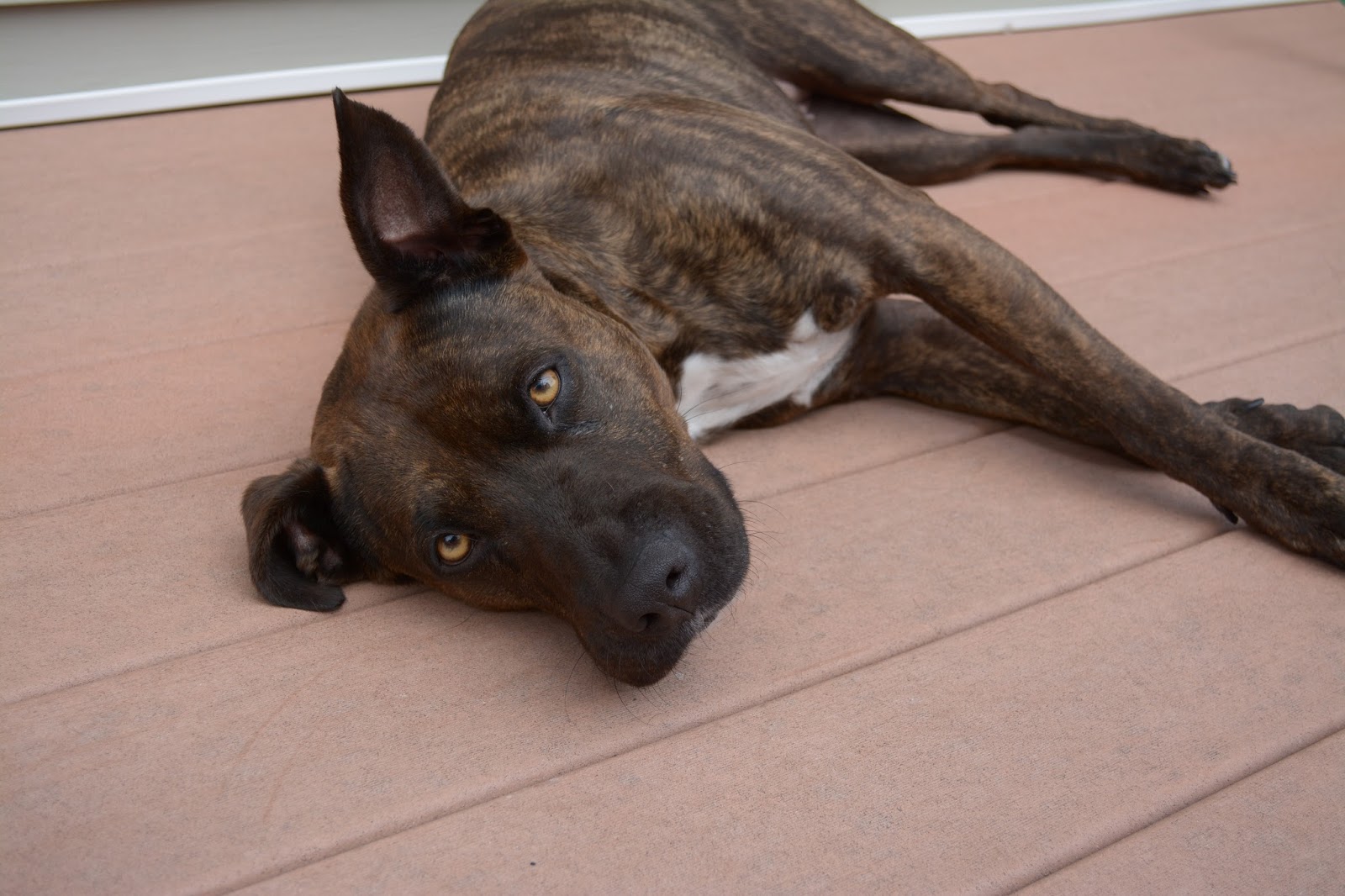
I hope this gives you some insight into your dog and can help you to be a better dog owner. Don't you want to be the best possible person for a face like this?

Resources and recommended reading on this topic. 
I have included so many resources on this one because I believe that understanding your dog is the most important part of owning a dog (short of feeding and medical care, that is).
Interview w/Pam Dennison on reactivity
http://www.dogcastradio.com/flashplayer.php?episode=155On Talking Terms With Dogs: Calming Signals, Turid RugaasCalming Signals: What Your Dog Tells You – DVD – Turid RugaasThe Other End of the Leash – Why We Do What We Do Around Dogs, Patricia B. McConnell, Ph.D.Stress in Dogs, Martina Scholz and Clarissa von ReinhardtThe Language of Dogs – Understanding Canine Body Language and Other Signals- DVD’s – Sarah Kalnajs


x

Sunday, September 20, 2015

Face It (Canine Body Language part 3)

As promised, I am continuing my efforts to tell you as much as I can while I still have your interest with part three of Canine Body Language.
Today, we talk about dog faces... actually their heads and faces in general. Now, I will preface this with saying that we as dog trainers and we as people tend to anthropomorphize dogs without thinking about it, when in reality we don't know what they are thinking. The best we can do is examine body language in a given context and what happened before and after. Based on the outcome of a given situation, we try to figure out what happened. That's all I'm trying to do here- show you certain characteristics that consistently pop up in dogs in certain situations and what happened before and after. That's pretty much the best we can do until we develop a way to read their minds, or dogs learn to talk like us. So, when I use terms like 'happy', 'mad', 'scared' or 'frustrated'; it's based on a situation and the outcome. Sometimes these things can be measured scientifically, but I can't run EKG's, ECG's or measure cortisol levels on all (or any) or my clients. I'll try to use neutral terms like 'relaxed' and 'tense' as much as possible, since I don't actually know their emotions.

We all (hopefully) know the difference between a dog that is relaxed and happy and a dog who is tense and upset, but here's a little quiz just in case:

Which dog would you rather pet?

Oscar
Random Internet Dog, lets call him Fluffy
 (http://www.dougrichardson.com/blog/dangerous-game/)

Did you pick the grey and white cattle dog mix here? 
Good  job! You get to keep your appendages... for now. 
Th reason you want to pet the cattle dog mix, Oscar is because he has what we call a 'soft' face. His facial features are relaxed, there is no tension in his lips, except that little bit required for a smile. His ears are facing outwards, not flattened against his head. There is no tension on his forehead and even the rest of his body is pretty relaxed. He's looking at his mom, who is holding either a treat or a squeaky toy- both are the best thing in the world to him. Oscar is a super sweet boy who lives in a house with other dogs, cats, and frequent visits from children. You'd be well-advised to pet him and he would be eternally grateful.
The other dog I found when I did a Google search for 'growling dog'. I decided that he looks like a "Fluffy", so for argument's sake that's this pup's name. Fluffy is displaying some pretty threatening behaviors. Hopefully if you see a dog like this, you choose not to approach and pet them- for your sake and theirs. I'll get into that in a minute, but first I want to talk about Fluffy's face. The most noticeable thing is those pearly white teeth. Baring teeth like that, and to that extent (more than just a few front teeth) shows that Fluffy is giving a warning "See these teeth?! I will use them!". I'm willing to bet that he means it, too. It looks like this little guy has dilated pupils, but we have no way of knowing the lighting in the picture since it's on a white background (odds are, the pupils are dilated because of stress and not just light, though). Pupil dilation is important because when an animal senses fear, the pupils dilate as part of the fight/flight response controlled by the sympathetic nervous system. His ears are back an down ever so slightly- he wants to hear everything in case the attack he perceives is on more than one front. There's more with his tail and body stance that tells us he's uneasy, but that is for another post.
Odds are that Fluffy is really, really uncomfortable with the situation. The situation can just be a camera that looks creepy, or a person who seems scary. Fluffy's comfort level is all up to him, we have to respect that and work with it so that he can gain some confidence. 

Ok, that was pretty easy. Let's make it a little more challenging. 
What do you see with these two dogs, and which one would you rather pet?
Jake
Joie


Jake, the yellow labrabor, right?  Now lets talk about why.
Look at his head, there is no tension there- you can even see a little wrinkle if you look closely. His tongue is out because this picture was taken in August during a birthday party so he had been playing with his human siblings. You can't see his eyes well because if the lighting, but they are just like Oscar's in the previous picture. His face doesn't look as 'soft' as Oscar's, but that's only because he's panting. His ears are relaxed and down.
The black pit mix here is named Joie. She is a sweet, loveable girl who is overrun with anxiety. She is in a down stay, off leash but is still nervous. Her pupils are dilated even though it's fairly bright outside and she is doing a tongue flick. The tongue flick is an indicator of a stressor or something the dog is unsure about. It is partially directed at me because cameras are like big, scary eyes which make noises unpredictably. If you look at the top of her head, it looks like her skin is stretched tightly over her skull. At the sides of her mouth, you can see where her lips are sucked in tightly and tense. If you look at her ears, they are almost pinned back to her head as well. She has had a rough life with a few traumatic events in the family and subsequently reacts to all kinds of noises. Had I reached out to pet her instead of take her picture here, she would have smiled, licked me, and wagged her tail happily. If she were a dog I didn't know though, I would not reach out so brazenly. Instead I would let her come to me with the temptation of treats or a toy instead of push her past her comfort zone.
Good job! You are getting really good at this!

Next, which dog would you pet?


Roxie

Pollo
Did you choose the pit mix, Roxie? She's a wonderful dog, and I may be a little biased because she's my very own brat-dog. She's laying down on one side, which is our first indicator that she is pretty comfortable in her environment, but there's more. Look at her eyes compared to Pollo's. Yup- not dilated and you can't see the whites of her eyes. What Pollo is demonstrating perfectly here is what we call a 'whale eye'. There is something bothering him to his left, so he is looking away but doesn't want to look away completely. As I recall, there is a frisbee nearby that he wants, but his buddy Darwin owns it. He had a questionable start to life, so he is learning to accept people and new stimuli in his forever home.
Just to be clear, here is a photo of Roxie looking at something to her left. You can see some of the whites, but this is not a 'whale eye'. Her ears and forehead are relaxed (you can even see wrinkles on her forehead) and her eyes don't have that peeled-open look like Pollo's above. There's more about the rest of her body that tells us she is more curious than worried, but that's another post!

Roxie
 While we are on the subject of eyes, I want to talk about the 'hard stare'. In this picture, Roxie is staring at me because I am taking her picture and annoying her by asking her to stay when there is a toddler running around the deck with a pitcher of water (water is her Kryptonite). The look on her face isn't quite a 'hard stare', but if I didn't know her I would move slowly.

"If he comes over here with that water, I'm gone... for good this time!"
Ok, last one for today. Who here is stressed out, who is excited and who is just hot?
Violet

Jake

Ryder
So, this one is a bit more tricky and that's because we are looking at their tongues- this is a bit more subtle. 

Ryder is the stressed dog here, and aside from the dilated pupils, tight skin on his head and pinned back ears, he has what is called a 'spatulate tongue'. It looks like his tongue is stretched out at the edges as far as it can go. To his credit, it was also a warm evening, but there were lots of people around at a birthday party and he gets excitedly stressed with lots of people. He's a super sweet boy who probably wouldn't hurt a fly unless it threatened his human brother and sisters. If I saw this in class, I would have him get some distance, go for a lap outside the classroom or get him busy with a trick, game or cue. If he can't take treats or listen when he looks like this, he really needs a break. 

That leaves one excited dog and one hot dog. (This should be pretty easy with Jake figured out). 
You got it. Violet is excited and Jake is hot. 
Jake is still at a birthday party, having lots of fun running around with kids but it's August on the eastern shore so it's pretty warm. His tongue is out but the edges are more rounded than flat and his face is a little more relaxed than Ryder's. 
Violet has her tongue out in anticipation of a toy, and because she's happy that Matt is petting her. She loves attention from people. Her tongue is out, but not flattened at all, so she's not terribly warm and she's not stressed at all. 

Good Job! You made it through with all of your digits intact (hopefully). Look closely when you are with your dog this week and see what you learn! 


Resources:
Canine Body Language: A Photographic Guide, by Brenda Aloff.
https://en.wikipedia.org/wiki/Fight-or-flight_response


Monday, May 18, 2015

Honesty Really is the Best Policy (Canine Body Language Part 2)


I love it when new clients call or email before a consult and say something like "I'll have to muzzle her", "don't wear a hat", or "you can't shake our hands because it really freaks him out".

I love hearing these things because it gives me an idea of what to expect from a dog that is new to me. It also gives me an idea of how responsible their human is- someone who wants to avoid me being mauled by their dog is a person I would much rather work with than someone who wants me to  "see her at her worst".  I really, really don't want to be a guinea pig- I want to see your dog's behavior firsthand or on video if possible, but I can generally ask enough questions to get a good idea without fighting off a dog attack. When someone describes a detailed routine that they use to have their dog greet new people, I learn that they are at least trying something to prevent incidents.

Whether we end up going in a different direction or trying a different protocol, I am more than happy to work with clients like this.

When I worked as a vet tech, it was the same way. Sometimes it meant clients being put into two time slots in the schedule, or bringing a dog-aggressive dog into the clinic through the employee entrance. When clients came in with their dog already muzzled, or they told us "he's better when I'm not in the room, so I can wait in the lobby", it showed not only how well they knew their dog and themselves, but how much they trusted us. Their honesty with us was a big factor in that trust ever developing, since trust is a two way street in any relationship.

Why should this matter to you?

Well, it's Dog Bite Prevention Week (read more here) and it seems like a fitting time to remind all both of the readers of my little blog (thanks Matt and Heidi) that knowing your dog can save you, strangers and the pet professionals in your life. Your dog may never bite or attempt to bite anyone in her life, no matter how many times she may be pushed, but it is still good to know some basic body language so your dog doesn't have to feel uncomfortable and so you don't find yourself on the wrong end of a dog bite(... not that there really is a good end to be on when there's a dog bite...)
So, people who have reactive or fearful dogs have had to learn the hard way what body language means and you have me to help you learn some simple things.

-Tenseness in his face and body, especially if his whole body seems tense it means he needs a break from the situation or at the very least a good distraction- redirect him to you and ask for a sit, for example. The dog pictured here was unsure about the situation she was in (loud, unexpected noise) so I used the flash on the camera to highlight the tension in her body. We quickly redirected her after I snapped the picture so she wouldn't get more upset. 


In this picture, Roxie is relaxed and tolerating Ethan's shenanigans. There is little to no tension in her face and her body is relaxed. She is extremely tolerant and gets plenty of breaks (and treats).
See the difference in their faces? Look at the top of the head of the dog in the above picture- there are no wrinkles and her skin and hair seem to be flattened to her skull; Roxie has a couple wrinkles and her skin is actually loose looking.
-A 'hard stare', like the dog in the picture in the link below (I don't have any of my own pictures of a hard stare, sorry). The dog is staring intently and seems to be otherwise unmoving. This kind of stare from a dog would result in me dropping/tossing a treat, clapping my hands, making a kissy sound or taking one step to the side (as long as he is on leash and not reactive to unexpected movement from people)- something to distract him and break him out of it. This kind of stare is seen at times before a growl, bark or pounce. It is sometimes defined as a stare held for longer than 2 seconds. Now, this dog is laying down and seems otherwise relatively relaxed, but I'd still interrupt and have that kid moved away from the dog safely:

-If his pupils are dilated, like the dog pictured in the above link he is similarly unsure or feels threatened. Pupil dilation happens as a fear reaction because the body is trying to take in as much information as possible to find a safe escape or resolution.

-His tail is an obvious indicator, but is only part of the equation. A happy tail is a tail that is wagging loosely, in line with the body. An unsure tail is one that is tucked. A tail that is in play and/or prey mode can be held high, almost straight up. If the tail is low but wagging, he is likely conflicted. Here, Violet is happy and loosely wagging her tail level with her body. The rest of her body is relaxed and her face has little to no tension. If there is any, it's because of the frisbee that's out of the picture, which she had to put down a minute ago. 

Compare that with her tail below, tucked tightly because she doesn't want Oscar to get too friendly. If you can see her face, her pupils are dilated and she is quite wide-eyed. She even has a little bit of what we call 'whale eye'. Her eyes are wide open and you can see the whites of her eyes because despite her discomfort with the situation, she doesn't want to let Oscar out of her sight. 
I will admit that we did not move fast enough with this one- she did jump up and snap at Oscar about 3 seconds after this. I was actually looking more at Oscar than Violet in this one, so I didn't see the whole picture. Otherwise I would have had Oscar immediately moved away from her and I would not have attempted the photo. They got over it though- he's learned to be more polite and she is a bit more tolerant. 

-Avoidance- If a dog is turning or looking away from something, like Roxie is getting up and turning away from a young Ethan with a cup full of water (her Kryptonite), they need an escape. If left cornered, some dogs will resort to biting in defense. 
No worries, After I took the picture I grabbed Ethan and the water cup and let Roxie go inside to escape the terror. 


 All of that said, there's more. I'll do another post on body language next week as a follow up, but this is a good start for you. The important thing to remember with body language is that you have to look at the whole dog- not just the tail or face. You have to see everything in between too; know the situation and how the dog is when relaxed so you have a baseline. There are different levels of relaxed, excited, agitated, worried, etc. for every dog.

You have homework this week: find your dog's baseline- take pictures of your dog, in everyday situations and in situations that your dog is unsure about (as long as you have at least one other person to help out with leash handling and removal of stimuli if/when necessary). It's amazing how looking at a picture can show us so much more than we see in real life. Getting to know your dog is the first step to communicating well and making the world a better place for you both, especially if you have a fearful or reactive dog.


Tuesday, September 23, 2014

Hello There!

Ok, this week's post is going to be pretty short but sweet for three reasons:

-I found it already written out perfectly by someone else and there's no need for me to just re-write what has already been said.
-It seems like this is all I've been working with lately- dogs who are fearful or shy and stubborn strangers who think they will be the dog's best friend.
-I am super busy the rest of the week and this is honestly all I have time for. I promise I'll post something of my own next week.

Roxie tolerates hugs from Ethan, but she'd rather be chasing a bird and stealing his snacks. 

The diagrams are especially useful here in demonstrating how rude we really are to dogs at times. As canines, dogs are inherently not as comfortable with the types of greetings we as humans use. They have learned that we are not meaning to be threatening when we hug them or lean over and pat their head. It's still weird and it's even more weird when a stranger does it.
For a dog, a normal greeting means approaching at an angle (about 45 degrees or so) so that you aren't charging head on at them- this would be a threat. Avoiding direct eye contact when meeting someone for the first time is a very safe habit in the dog world- why start a fight right away?
Sniffing is the other important part. We people talk and exchange pleasantries when we meet ("where are you from?" "What do you do?", etc). Dogs can skip the small talk and smell to find out that and so much more (who they are, where they are from , where they went today, what they had for lunch, if they live with another dog or a cat, etc.). This is why it is important to allow a dog to sniff you (not force them to sniff) to gain some understanding of who you are.

Oscar does love a good ear rub from his buddy, Matt. His body is relaxed and he is leaning into his friend. 

As you can see from the date on Dr. Yin's post below, this is not terribly novel information, but I can tell you and my clients can tell you- it's important information to know.

http://drsophiayin.com/blog/entry/preventing-dog-bites-by-learning-to-greet-dogs-properly?utm_source=hs_automation&utm_medium=email&utm_content=9425426&_hsenc=p2ANqtz--zO0EQSbmC3Q4L1VPysXv4INwNqhcByQFaLVonrCFi7xLYWVXnKFnagOGdZi847qUCteRe1LwegDw3UTB46kCkQTzIDQ&_hsmi=9425426

Have you and your dog experienced a rude greeting?

Monday, August 25, 2014

Calm Submissive State, My A%#.

My blood pressure has been rising almost exponentially lately whenever I hear about other trainers who look down on or dismiss the effectiveness of reward based training. These trainers are always spouting someone else's mantra about your dog needing to be in a "calm, submissive state". They are even right here-gasp-in my hometown. They are claiming that there is a limit to what you can do with reward based training or that after a certain age, you simply need to switch to using compulsion-based methods to get results.

I'm calling shenanigans.


Think about it in human terms, if it helps. If you are relaxed, laying on the couch reading a book, that's a "calm state" right? If someone bursts through your front door and begins to threaten you and your family, you'll switch to being in (some degree of) a frightened or submissive state. Are you still as relaxed as you were when you were relaxing on the couch reading your book?
Doubtful.
 My point is that it is physiologically impossible to be both calm and submissive at the same time. This is true across species. When you are calm, your heart rate is at a normal, low rate and your respiration rate is even and relatively low. Muscles are relaxed and your body posture will reflect that. On the other hand, when you are feeling submissive your body will reflect that you are unsure and on edge. Your heart rate and respiration rate will be (even slightly) elevated. Say you are in this unsure, submissive state and you are then given a random, unrelated written exam or multiple choice test...in Japanese (it's a notoriously difficult language to learn). How well are you going to do? Will you be able to focus and learn new things while in this environment? Will you retain it? Will you want to learn more from this person?
A dog who is calm is comfortable, relaxed, serene, tranquil and safe.
A dog who is submissive is unsure, anxious, meek and passive.
The two cannot exist together in the same animal at the same time.

Quick history lesson:
Compulsion based methods have been used widely since the first days of dog training in the early 1900's (military dogs during WWI) and back then, we honestly didn't know any better. Things like alpha rolls, scruff shakes, choking, etc were originally used because it was a fast effective way to get a dog's attention and slow them down to give the human the advantage.
Unfortunately, these are still fast, effective ways to get most dogs to stop demonstrating any given behavior. They are not resolutions to behavioral problems, and the dog does not suddenly respect the trainer/handler who is using these methods. The dog is likely shutting down because they are mentally overwhelmed and literally cannot respond any more (we call this "flooding")and has stopped fighting back because they feel their survival is at risk (this may or may not be rational). The dog is learning to distrust that person. Over time, dogs stop doing just about anything (even new behaviors) that may get them in trouble. This is called "learned helplessness"; the dog has learned that they can have no impact on their environment so they stop trying.
Back when dogs were first trained to do work and these methods were implemented, it was believed that any dog who did not respond well to training was simply not capable of being trained.
Using these methods, training cannot start until the dog is over 6 months of age. Ever wonder why? First of all, the physical force could do serious damage to young puppies, that's pretty obvious. The other thing is that this is after dogs have grown out of their Fear Imprint period in development and they have an understanding of what things are good and what things are bad in life.
Sure, go ahead and slap a prong collar on him- that won't be at all confusing.

What I'm trying to explain is that these 'trainers' who go on about a "calm, submissive" dog are so full of it I'm waiting for them to explode. The terms are made up. Their methods are antiquated at best and abusive at worst. Most of them don't even have an actual education beyond attending a few seminars on these methods. They have no real knowledge of Behavior, Cognition, Development or Learning Theory and they wield tools meant to cause harm.

You know why positive based training methods started being used and how clicker training developed? Marine mammals- you can't really punish a whale or a dolphin. They swim away and don't want to interact with you if you are a big jerkface. We had to come up with a way to motivate them to want to hang around and interact. Yeah, yeah that initially involves food rewards. Big deal. We ALL like rewards and food is something we can provide easily to animals when we train. Then we fade it out. Check out my post on bribery here to learn a little more about proper use of food in training.  What's wrong with that?! I'm not saying your dog gets 3 Big Macs every day, his own meals can be the reward if you're worried about weight gain. Food is a different topic entirely anyway, so I'll stop with that here.

I was recently watching a video another trainer in my area has on their website of a "before and after" of a dog who is trained using a prong collar. The "before" is a brief moment of the dog on camera reacting to another dog. The "before" dog is a dog who is excited, pulling on leash, jumping and doing a bit of barking. The tail is up a little higher than it would be for normal friendly play, and she appears to be switching between a play bow and a prey bow, so I would agree that there is some degree of over-stimulation at play and potential for trouble. The dog is not displaying outright aggression and appears to have a generally loose body (no tension, no crouching) which indicates that aggression is likely not going to be her first response. This does not mean that it is out of the realm of possibility, given her arousal level, so I would agree that this dog does need help coping with the stimulus. The "after" is after the trainer and owner have worked a few times with the prong collar on the dog so the dog understands the pressure placed on her by the collar. The dog after the prong collar training could be a different dog, and I don't mean that in a good way. She is nervous, anxious and unsure about everything. Her tail is low and almost tucked, she is completely avoiding eye contact with the other dog and is panting in an environment where the people are wearing pants and jackets. She is stressed out.
But she's submissive as she can be.
You know what she's not?
Calm.
She's not "calm, submissive" because that DOESN'T EXIST.


Would you be calm if you had this around your neck?

With reward based training, I'm not going to try to change your dog's state or your state- I'm going to give you both tools to communicate and cope with challenges you will face in life together. With reward based training, the goal is to strengthen the bond between you and your dog. Pain and force are not the way to strengthen any relationship, and neither is bribery; which is why I don't use either. It's also why any trainer with an education in canine behavior, cognition and learning won't use them if they want results without dangerous side effects. I also don't just teach cute tricks to dogs using food rewards. I teach owners to communicate effectively with their dog; how to read their dog's body language so they understand their dog. I teach basic commands to help build a bond and use fun games to ensure both canine and human are having fun and thinking. You can have fun and still learn at the same time, you know. Ask a first grader about school this week. Do they have any fun during the day? Do they learn anything? Odds are, if they get to do both they are looking forward to the rest of the school year and the rest of their education in school. Why not set up a similar learning environment for your dog?


Resources:
Excel-Erated Learning by Pamela Reid, PhD (Flooding- pgs 115-116; Learned Helplessness pages 98-99)
Canine Body Language; A Photographic Guide by Brenda Aloff
Reaching the Animal Mind by Karen Pryor (chapter on Fear, pages 115-132)
http://www.bbc.com/news/uk-england-hampshire-25147640 (article on first recorded use of Military dogs in WWI)
Animal Behavior College Dog Trainer's Curriculum (Use of Military Dogs: pages 4-6)

Friday, August 8, 2014

Book Review: It Doesn't Matter, Just Scroll to the Bottom for the Name and Buy This Book

I've been slacking lately. Actually, I have been working on a couple of posts that involve a bunch of research and I have been working with actual clients a bunch lately. So maybe "busy with other things" could be subbed for "slacking".
Anyway, I figured that a book review would be a relatively quick, informative post and I have read tons of books so at least that part is done already!

The first book I'm choosing is one of my favorites (I'll say that a lot, but I REALLY mean it this time). I have read it cover to cover like a novel a few times and I recommend it to clients constantly.
The book is called Canine Body Language: A Photographic Guide, by Brenda Aloff.
The title kind of takes all the mystery out of it, but I'll do a brief discussion just for fun. The book is all about canine body language, and interpreting the emotional state of a dog. Now, there are those who frown upon us trying to determine a canine's emotional state, because that's attributing human traits to a non-human animal, etc... but I believe that dogs are just as capable of us as feeling scared, happy, sad, stressed, angry, frustrated, and everything else we feel. You can disagree with me all you want, but after living and working with different animals my entire life I'm absolutely convinced that I've seen it. I'm going to list all the main topics covered by the book, followed by an example or two from each chapter.

Canine Body Language starts out with a review of determining a dog's emotional state. The first section reviews relaxed/neutral, confidence, curiosity, rolling, companionship, stress signals, fear indicators, caution, anxiety, avoidance, and smiles. Let's talk about an easy one to start with. 
A 'relaxed, neutral' dog can look like, on different dogs and in different situations. In general, a 'relaxed, neutral' dog has no body tension anywhere, has a semi-open mouth, and is blinking normally.

The thing is, this (and everything) can look different on different dogs in different situations. Everybody thinks that a dog with a wagging tail is happy, and that is sometimes true. Check out my post on tails here from a few months ago. Dogs use their entire body to communicate, so to understand them we need to look at all of it. This includes, but is not limited to:
-Tail
-Mouth
-Stance/Body Orientation
-Ears
-Tongue
-Lips
-Eyes
-Overall tension (or lack thereof) in the body

To get an understanding of what a dog is (likely) feeling, you need to look at all of these, and the book gives great examples of pretty much everything. That's why it's almost 400 pages long.

I also want to point out confidence. PLEASE, PLEASE, do not confuse confidence with dominance. They are not the same at all. There can be elements of confidence in an aggressive dog, or a dog who is trying to control a situation (rightly or wrongly); and there can be confidence in a dog who is performing fantastically on an agility course. Confidence usually involves the body being forward to a degree but not too far, and of course you have to look at the rest of the body (seeing a trend here?).
Section two discusses Calming and Negotiation signals. Blinking, look away, tongue flick, sniffing, shake off, stretching, yawning, paw lifts, and puppy licking. A dog who is yawning is not bored with you (probably). A dog who is yawning is a bit stressed by something in the environment. That something may be a camera taking a picture of them, or another dog who is being pretty threatening.

Section three delves into more of the neutral and friendly indicators and signals. Butt sniffing, inguinal sniffing, friendly, greetings, the "I love you" stretch, pass by and look away. The pass by is actually a good, normal way to gauge how two dogs will like each other. I call it 'going for a walk', and it involves at least two people and two dogs. The dogs are kept on leash and walked past each other, like two ships passing in the night. The third person can be useful to look at both dogs at the same time so their handlers can focus on walking. If both dogs remain relaxed during a pass by, it may be safe to try a walk together. If one or both dogs exhibit predatory or over-stimulated behaviors, that's probably not the best idea (at least not yet).

Section four highlights responses to invaded space, including aggression, alerting, targeting, corrections, warning, and guarding. Targeting is a great example from this chapter. My Roxie demonstrates this perfectly when she sees a cat, squirrel or another dog. She leans forward, lifts a paw, has a high, stiff tail, forward ears, and is very still. It's actually the beginning of a stalking behavior and recognizing it as such can be a great way for pet parents to prevent a bad situation form happening or pick out your dog's favorite toy from the floor.

Section five reviews predatory behaviors, like excitement, prey bow, stalking, and chasing. The prey bow is often confused with the play bow, and this is where a lot of dogs (and their people) get into trouble. A prey bow indicates to dogs that the 'game is afoot' and there will now be motion. There is tension in the body (noticeably absent in play bow), the body is oriented backwards but in preparation to spring forward, head and tail are up (tail is down during play bow), and the mouth is generally closed (mouth is open during a play bow)

Section six is more lighthearted and is all about play! Normal play between dogs, play biting, play bows, role changes during play, prey-predator switches in play, conflict and taking breaks, and play that is turning into something else. People ask me all the time what normal play looks like between dogs. I tell them that taking breaks, taking turns and nobody picking on someone constantly are normal and that depending on the individuals playing, it may look a little rough. Reading through this book is a great way to have an idea of what's normal.

Once you get through the book, you can take the quiz in section seven and give yourself a pat on the back for doing so well on it! If you don't, you can always read it again.

I'll say it again, I love this book. I recommend it to everyone with an aggressive dog, or an anxious dog, or anyone who takes their dog to the dog park. I recently ran into someone who refers to it as the 'dog Bible'. I kind of agree. If I could send one to everyone for the holidays, I would do that instead of a holiday card.

If you really like it, here's a few links to buy it to save you the Google search :)

Directly from the author's website:  http://brendaaloff.com/shop
Amazon: http://www.amazon.com/Canine-Body-Language-Photographic-Interpreting/dp/1929242352/ref=la_B001K7WXGQ_1_1/185-1689417-1229234?s=books&ie=UTF8&qid=1407524043&sr=1-1
Dogwise: http://www.dogwise.com/itemdetails.cfm?ID=dtb856


What's your favorite dog book?

Wednesday, March 5, 2014

Chasing Tail: Canine Body Language Part 1

My post last week about dog parks inspired me to discuss something too many puppy parents know all too little about- tail wagging. We've all heard someone say it, there have been times we've even said it about a dog: "if his tail is wagging, he's happy". The truth is that it's not always true. A dog's tail is just one part of his body used for communication, and just one thing we as puppy parents need to be able to decipher so we can understand our dogs.
Dogs communicate with their whole body, we simply aren't always good at putting all of the pieces together- I want all puppy parents to be better at that, if nothing else. With an understanding of what your dog's body language you can be armed to help your dog feel comfortable and keep everyone safe. So, this is part one in my series on canine body language. There will be a bunch of parts to this series... It may go on for months to be perfectly honest with you. It's that important. I'll try to include pictures as often as I can because I'm a visual learner and I like pictures of doggies (you know you can't argue with that logic).
Where was I? Tails- that's right. A dog's tail is one of the most easily noticed part of his body (unless your dog is a breed that is docked or has a naturally short tail) which is used constantly in communication with you and the world around him. For now we'll focus on just the tail- not everything else that's going on, because it's easier to start you in the shallow end than toss you in the deep end of the pool.
-You have probably heard that a dog whose tail is wagging means he is happy. This is true if his tail is wagging LOOSELY and EVEN with his backline. Picture a golden retriever wagging his tail. It's pretty level with his body, and is waving gently back and forth. This type of tail wag is a happy tail wag. If the rest of his body is pretty relaxed you're probably safe to pet this one. Here is a video of a past client, her name is Sydney and she is a sweet, loving girl who pretty much loves everyone and everything. This is a clip from one of our training sessions where we were working on less rambunctious greetings. As you can see, she is wagging relatively even with her body, loosely and she is otherwise pretty happy. If you were to pet Sydney, she would lick you all day long as a thank you. 


-A dog whose tail is wagging, but with the tail positioned up as opposed to level with his body can indicate a dog who is excited or on alert for some reason. Some breeds tend to always wag this way (pugs, huskies and other curled up tail dogs), but if your dog can relax his tail, look out for this. It's not necessarily a bad thing, it just means your dog is a bit more excited than normal. If you know your dog gets over excited or reacts to other dogs, cats, people, or anything and you see the tail go up and wag stiffly, it's time to redirect and prevent a sticky situation. In this picture Roxie's tail is almost straight up and stiff. If it were to wag, it would look like a little flag being waved back and forth. Hee ears are also up and back, indicating her interest in something. What you can't see here is the cat that just caught her eye- she thinks cats are great things to chase.


-A dog whose tail is down is unsure, and possibly nervous. The further tucked his tail is between his legs, the more pressure he feels from the situation. If your dog's tail does this, he needs a break from the situation or stimulus that is pressuring him. Please allow him a safe 'out' here, with you to support him. Dogs who are unsure, nervous and feel cornered are so scared that they can and will lash out at just about anything, especially anything new or scary. In the two pictures below, Blair is meeting a very calm, dog savvy girl during class. If you look at Blair's tail it is low, not quite tucked, but not up much from her legs. In the second picture, you can see that she is wagging her tail in this same position. Blair has had a few overwhelming greetings from strangers and is cautious with new people. No worries though, be the last week of class, she was pulling over to play with the girl and her sister, who gladly rewarded her bravery with gentle pets and kisses (probably some treats too!)


-Wagging stiffly vs wagging loosely- generally speaking, when a dog's tail wags loosely it means he is somewhat ok with the situation. When a tail wags stiffly, they are a bit more undecided and waiting for more information from the situation.

 In addition to my experience living and working with dogs, I have read a bunch of books-and have about 20 15 more (I read some of them!) on my Nook waiting for me to read- and compared notes with my other trainer friends to get this information. One of my favorite resources is the book listed below. If you have a reactive dog, a fearful dog, and aggressive dog, heck- a LIVING, BREATHING DOG, do them a favor and pick up a copy of the books below. They are both great resources for dog owners, especially if you have a new, fearful or reactive dog. Another great thing is to take pictures of your own dog- in everyday situations and in stressful ones (as long as you have someone else to help so nobody gets into trouble). Going back and looking at pictures of moments in time can really tell you a lot about your dog!

Resources:
Canine Body Language, A Photographic Guide: Interpreting the Native Language of the Domestic Dog; By Brenda Aloff
On Talking Terms With Dogs, Calming Signals; by Turid Rugaas