Pages

Thursday, November 12, 2015

The Way A Puppy Grows

Maybe you don't have a mother and aunts who love to sing like mine, but I have this one stuck in my head from my aunt singing it to our son the other day:

"Oh, I think it's rather silly, 
the way a puppy grows
a little on his waggly tail
a little on his nose
a little on his tummy
a little on his ears
I guess he'll be a dog alright
in half a dozen years"


I'm certain they didn't come up with the catchy tune all by themselves, unless perhaps you ask them, but it got me thinking about the way a puppy grows. I did a post a few weeks ago about the importance of a good breeder, because that initial environment has a big impact on who that puppy grows up to be.

As an example of the impact, I have a client who has two dogs from of the same breeder, same bloodline, bought a few years apart.

The one pup (we'll say Fido for simplicity sake) is friendly, social and accepting of people and has been from the beginning. Their other dog (Fuzzy) is reactive, nips people and barks (a lot) and has since they brought them home. When they got Fido, they were brought into the house where the puppies and their momma were living with the human family. They were exposed to the family including children, older family members and cats. When they got Fuzzy, the dogs were staying in a nice house of their own without people constantly around. They were well cared for, clean and healthy looking.  Fuzzy's litter was not exposed to various people and other animals. Fuzzy is reactive and fearful, Fido is friendly and confident.

Let's take a look at what happens those first 8 weeks, before puppies even go to their new home, and why it's so important.

Neonatal Period: Days 1-12
The puppy is pretty helpless at this stage, eyes and ears are not open, motor skills are limited, cannot regulate their own body temperature and need stimulation (licking by momma) to pee or poop. Puppies in this stage will whine or cry to attract their mother's attention, and already has a sense of balance, taste, smell, touch and can detect changes in temperature (meaning they will move toward warmth). Even at this stage, the environment will shape the puppy. Gentle handling such as picking up and holding and moving to a slightly different surface for a short period of time (less than a minute) will help the puppy later on:

"If puppies are handled and exposed to mild environmental stressors, it can have a positive impact on them in later years. On the other hand, pups left undisturbed or raised in isolation during this time can be emotionally reactive when they reach adulthood. You may not see visible signs until they reach adulthood, because the signs are so subtle that the novice eye would not recognize them as a potential future problems." *1

"Mild stress of the neonatal dog, such as induced by handling or placing the puppy on a cool surface, increases the puppy's ability to cope with stress later in life" *2

Transitional Period: Days 11-21
Motor and sensory skills start to develop, eyes and ears open, and they start to walk instead of crawl with trepidation. Their teeth are coming in, so they can start on soft meals (sometimes regurgitated by their momma), even though they will still be nursing for a few more weeks. Louder vocalization occurs when they are left in a new environment and since they can hear, they will initially startle at noises. At this age they also start to navigate away from their nest or den to go potty, because they can go potty without mom's help and realize that they don't want to sleep near that. Up until this point, their sweet momma has probably been eating their poop. The puppy is able to adapt to new stimuli and develops the senses through experiencing new stimuli like handling, playing with toys, experiencing new types of floor, bedding and climbing on stuff (not unlike human babies). Play fighting will begin during this time and positive reinforcement training can be used to teach them (by their mom or their humans). An interesting side note, potty training is already starting at this point and what happens here will have a lasting impact:
"From this point on, the puppies should have the possibility to leave the nest site to eliminate. Puppies who have been thwarted from doing so may become almost impossible to house train." *3

Socialization Period: Weeks 4-14
Social play is the primary endeavor at this time, as puppies are learning social cues and subsequently, the rules of normal play. This is also the time when they learn all about people-what they are and what they do. Puppies can be taught cues and behaviors using positive reinforcement and they are learning about bite inhibition from their litter mates. Spending time with people and their litter will ensure a well-rounded dog who is comfortable in different social settings. Through play fighting, they experiment with biting, grabbing, shaking and holding. Puppies start to learn about bite inhibition when litter mates yelp at too hard a nip or grab. The yelp will (typically) stop play for a moment because of the alarming sound. 
"Socialization to dogs and to people has to occur during this time. If this opportunity is missed, he puppy will most likely always be fearful of dogs and/or humans. During the socialization period, the puppy should also be exposed to all situations that it is likely to encounter during its life." *4

Hold on, Now here's a really important part of the Socialization Period:

Fear Imprint Period: Weeks 8-10 (or more)
At this point in development, puppies will retain fearful experiences/stimuli which they encounter.
"If 5 week old Beagle puppies were punished (e.g., with an electric shock for approaching a person), they shoed fear, but approached that person again when retested later. If the puppies were between 8 and 9 weeks of age, they retain the fear of that person...Any aversive experience during this time is to be avoided, since it may have lifelong effects on emotionality, anxiety, fear, hyperactivity and reactivity and aggressiveness." *5

That's it, just the first few months of a puppy's life and look at all that has happened in such short time! All of that stuff a puppy experiences before you even meet them for the first time really does impact who they will be.

There are more stages of development that your dog goes through, but we will stop here today because I've typed enough for one night and I think this is a good place to start. If you want to know more, you should check out the two books that I cited here, they are both great books.

Citations:

*1:
Raising Puppies and Kids Together, by Pia Silvani and Lynn Eckhardt  Page 12

*2:
Small Animal Pediatrics, by Michael Peterson and Michelle A. Kutzler. Page 188

*3:
Small Animal Pediatrics, by Michael Peterson and Michelle A. Kutzler. Page 188

*4:
Small Animal Pediatrics, by Michael Peterson and Michelle A. Kutzler. Page 189


*5:

Small Animal Pediatrics, by Michael Peterson and Michelle A. Kutzler. Page 190-191


Resources:

Raising Puppies and Kids Together, by Pia Silvani and Lynn Eckhardt (a great read if you have puppies and kids, btw.)

Small Animal Pediatrics, by Michael Peterson and Michelle A. Kutzler.

Tuesday, October 27, 2015

Food Bowl Woes

 I'll admit that we use a plethora of things to feed Roxie and a regular food bowl is at the very bottom of the list closet. Literally, in the floor of the hall closet collecting dust when our son isn't fishing it out to use as a boat for his animals.

We have a couple of food dispensing balls that she can roll around, a Buster Cube to roll around, a handful of Kongs and two Kyjen Slo-Feed Bowls that we alternate. We generally stick with the slo-bowls for her meals because her (human toddler) brother likes to help feed her and these are the easiest for him to help with. The Buster Cube we only use if we are heading out for a few hours since it's a little noisy. Her food-dispensing balls are used every other day or more and the Kongs are used a few times a week when I actually have the forethought to fill and freeze it before I leave- room temperature peanut butter is way too easy for her.

Sometimes, during a voyage with animals, the plain food bowl gets left out and our son is amazed that it can also be a vessel for Roxie's food, "like OUR bowl, mom?" Unfortunately, the novelty stops there. If we dare to feed the brat-queen with this strange stainless steel creation, she looks at the bowl and then I swear rolls her eyes before looking at it again and eating. Don't get me wrong, she loves food and this exchange lasts about 18 seconds, but I'm pretty sure she's ticked off about the bowl.
When we use any of the alternative food delivery methods, she jumps around a bit before sitting with her tail wagging so hard her whole body is wiggling around.

Why does she get so excited about eating her food in a different way?
Because it is a more natural way for her to eat. I am not saying she is a wolf and needs to hunt for her own food or that she would be able to catch her own food if she had to, but there is a level of predatory drive that just isn't provided by a plain, easy to eat out of bowl. When she uses the food-dispensing toys like the Buster Cube, the food falls out randomly and she smells around on the floor for it. This may be the messiest way to feed her, but definitely keeps her busy the longest. When she eats out of a Slo-Bowl, she gets to lick around and catch the little pieces of food as they slip away from her in the maze of a bowl. Sometimes, she goes back a few minutes later to see if there were and pieces that she missed. When she eats out of a plain, boring bowl, she comes to find us and glances longingly at her empty bowl. She gets the same amount of food no matter what we use to feed her, but 30 seconds of food feels like less than 10 minutes of chasing it around the living room.
Back to the natural way to eat thing. Dogs have evolved as scavengers in their many years living with people, so having to do a little more than scarf it down from an easy bowl is only natural.
You know what else it is? Mental and physical exercise. Mental and physical exercise are two of the most important things you need to provide your dog to help them be happy and healthy!! As a scavenger, she would have to search out food in all kinds of places and it would not be as easy as finding a bowl with food waiting for her three times a day. Even waaaay back when the common ancestor of current domesticated dogs and wolves was loping around, they were hunters and scavengers- they had to work to get their food.

Also, she eats slower so she is less likely to choke or get bloat or eat so fast that she pukes it all up (she's done this a few times in the past). Now, she's not a large breed so bloat really isn't a concern. I will say that with some dogs, the Slo-Bowls are not ideal to help with bloat because they get so excited/frustrated trying to get each piece that they take in more air, which really isn't what you are after. If your dog swallows a cup of food all at once, try feeding a little at a time and waiting a few minutes before giving more. Of course, with anything medical you should always consult your trusted veterinarian before reading anybody's blog. The food-dispensing balls and food puzzles are great though.

This week, do your dog a favor and recycle or donate that old food bowl and get a new way to feed! There are tons of different kinds out there and there is bound to be one that works for you and your dog.

Please, remember to always supervise your dog with any new toy or feeding device the first few times, so you are certain they won't eat it in addition to the food!

References/some of my favorite alternative feeders:

http://outwardhound.com/shop/dog-bowls

http://www.jjdog.com/product/Buster-Cube/Dog-Toys-Tugs-and-Rewards?utm_medium=shoppingengine&utm_source=googlebase&cvsfa=4436&cvsfe=2&cvsfhu=31333138&gclid=CP2Dlp6V5MgCFVcSHwodousEYw

http://www.kongcompany.com/products/for-dogs/interactive/wobbler-2/wobbler/

http://store.petsafe.net/busy-buddy-kibble-nibble

http://news.nationalgeographic.com/news/2013/03/130302-dog-domestic-evolution-science-wolf-wolves-human/

Monday, October 12, 2015

Picking a Winner (part 2)

Last week, I went through the reasons why you should care about the breeder you choose if you are going that route with your next puppy. This week, I have put together the things you should look out for so you know exactly who to avoid and what questions to ask. 
Whatever your reasons for wanting a purebred puppy, you should start with your veterinarian, trainer, groomer or even a breed-specific rescue. Typically they can point you in the right direction, or at least tell you who to avoid. A rescue may give you a little grief about not choosing them, but if you have good reasons, they will probably listen and offer advice.
We start with red flags; if you experience any of these with the breeder you choose, put on the breaks and ask more questions. If a breeder doesn't like you asking questions, you probably want to go elsewhere. 

One of these came from a reputable breeder


Red Flags:
-Meeting anywhere other than at the breeder's home
-Not being questioned about your lifestyle and family, including hobbies, work (hours per day and per week outside of the home), whether or not you have a fenced in yard, children in the home, etc.
-Not meeting with the breeder prior to getting the puppy
-An advertisement in a newspaper for litter 
-Little or no knowledge of the puppies lineage and personality
-No vaccination or de-worming records
-Dogs (including puppies) are kept exclusively outdoors or exclusively indoors*
-Puppies are wary of people
-Shipping puppy unattended
-Offer multiple breeds for sale
-Offer puppies for sale under 7 weeks of age
-Puppies available year round- litters are born many times each year
-Unhealthy looking mother, puppies or father- a nursing mom should be allowed sufficient food to maintain body weight and feed her puppies. If she is malnourished, her puppies probably are too. If she is sick, her puppies probably are, too. If the sire is on site and looks ill, ask questions. He may just be under the weather- which is fine, but you need to think about genetic problems that you may be taking home. When in doubt, ask questions (see a trend?)
-Offers 'designer' breeds 

*some toy breeds are kept indoors when young so they aren't carried away by prey birds

A good, reputable breeder will show you that they care about their puppies and the breed, so these things usually mean you are on the right track.

A good breeder will:
-Provide lineage of your puppy (and probably have it memorized)
-Want to meet you in person, before you get your puppy
-Have a puppy or a few puppies for you to choose from based on your lifestyle and the puppies' personalities- odds are you will not have your pick of the litter
-Have a waiting list
-Want referrals from you (veterinarian, trainer, groomer
-Have referrals from their veterinarian and a close relationship with their veterinarian
-Have clean and adequate space inside and outside for the puppies and at least the mother
-Only have a couple litters per year at the most
-Have a contract for you to sign, including requirement to spay/neuter and to return the puppy to them if you cannot care for them in the future for any reason, among other requirements
-Have at least as many questions for you as you do for them
-The earliest puppies will be available is 7-8 weeks, and if you need to postpone pickup because of work, vacation or a family emergency; they will hold the puppy for you
-Decline to sell you a puppy because of your long work hours, many kids or small apartment- depending on breed
-May offer "working quality" vs "pet quality" pups*

*Working quality dogs include any sporting or working breed that has been bred to do their job. A working quality hound is not what you want in your condo. A pet quality dog is just as healthy and well-bred, but does not posses (either by intentional breeding or genetic chance) the traits preferred for the breed specific work.

Keep in mind the breed you are selecting and your lifestyle; these things have to mesh well and your breeder will want to be sure that they do. Some breeders only breed working dogs, and may not often have "family pets" for sale. As frustrating as this is, it's a sign of a good breeder. If you have 5 kids under age 10, you really don't need a working quality Cattle Dog or Border Collie, trust me- it will be more work than you have time for to keep that dog happy and well exercised. If you really like a breeder who focuses on the working dogs, talk to them and explain that you would love a puppy who is pet quality. Not every pup in every litter will be working quality, so you can probably get what you want eventually. Some breeders focus more on family pet quality pups, and if they have any pups in a litter who are more working quality, they may have a special contract or a home already lined up that is appropriate for them.

A final note, remember that you are applying to buy this puppy, you are interviewing to have this pup. A good breeder may come across as snobby or rude, but they may have good reason for being selectively friendly. They aren't trying to make a sale, they are finding a home for one of their babies, so be kind and patient- it will pay off. Most good breeders do it as a hobby and to better the breed. not to make money.

For an example of a good, local breeder her on the shore, check out Marshy Hope Labradors. I'd love to come back as a puppy born here in my next life. In the meantime I'll have to make do with visiting when she has her next litter.

Did you choose a specific breed, and why?


Thursday, October 8, 2015

Picking A Winner (part 1)

This is actually the next in my series on choosing the right dog, but since this evolved into two parts, I used a different title. My mind works like that, are you telling me yours doesn't?
I'm not gonna lie, I started typing this two weeks ago and when reading it over today, I realized that it was going to be a two part post. My bad. I could have totally had a post last week and not been a slacker.
This is clearly part 1, which outlines the importance of choosing a good breeder. I am not in any way supporting breeders as opposed to rescue or adoption, just trying to help out people who choose to go that route.
When I meet with a new client, one of the many questions I ask is where they got their dog. I don't ask this so I can give a lecture on the impacts of buying from a breeder as opposed to rescuing a dog or the pitfalls of choosing a puppy from a pet store. I ask because the first environment that a dog has does make an impact on their personality. I have worked with dogs from reputable breeders, puppy mills and those found on the side of the road- the good news is that with time and patience, they can all be great dogs.
If you have the choice and you want to buy your next pup from a breeder, I'm not going to stop you and direct you to the nearest shelter, but I think you should be educated in choosing that breeder. There are some red flags that you should be aware of when selecting a breeder for your next companion and knowing ahead of time can save you a lot of headache and potential heartache.


First, why should you care about the early environment and bloodlines that your puppy comes from? The first obvious factor is genetics. A responsible, reputable breeder will have vast knowledge of the lineage of your puppy. The breeder cares about this because they want healthy dogs and they want to better the breed. Appearance and conformation are great things to be aware of and should be taken into consideration, but alone they do not make a great dog- good breeders select for demeanor too! Health concerns are another genetic factor- many purebreds are predisposed to health problems- your breeder should know about all the specifics for that breed and do what they can to avoid keeping these health problems in the bloodline. For example, large breed dogs generally will come with PennHip X-Rays, which are done to check for hip dysplasia. At the very least, both parents should have had these done.

I'm not going to delve much into the physical effects of poor breeding programs, but I will tell you that I have seen 8 week old puppies with grade IV heart murmurs and severe hip dysplasia- yes, at that age the entire litter of 9 puppies was diagnosed. These puppies were the result of extremely poor breeding; we found out during the course of the appointment that the parents of the litter were mother and her son (from a previous litter obviously). The person had no idea that this was not a good way to breed- the veterinarian explained.

As far as personality, it is very difficult to predict what exactly will happen in a given litter- it's a breeder, not a mind reader. What a breeder can do is know the two dogs they are pairing for a given litter and select them based on demeanor in addition to health and appearance. If either parent has a history of serious behavior problems, they should not be selected to breed because it could very likely be passed on to puppies.
Aside from genetic factors, the early environment that a puppy experiences can have a huge impact on who they become. Dogs who are abused, neglected or otherwise ill-cared for show that as adults.

WAIT!

Time for a super quick, simplistic review of puppy development.
For the first 12 days, the puppy is completely reliant on the mother for their care and can't do much more than poop, pee and nurse.
Around 2 weeks, the puppy begins to control bodily functions, the eyes open and they start to wag their tail.
Starting around 3 weeks, puppies begin to develop awareness of their environment and begin to learn some canine behaviors. At this stage, they can also differentiate between human and canine behaviors (if exposed to both).
At 7-10 weeks, most puppies are ready to wean and go to their new homes and begin learning some manners and basic cues, as well as how to bond with people and other animals (using reward based training, of course).
At 5 weeks, the fear imprint period can begin, though it typically peaks at 8-10 weeks. Scary things at this time will remain scary for a long time.
There are more development periods, but that is for another post.

These periods matter because if a puppy is in a less than ideal environment, it will have an impact on their development. If a puppy is born to a mom who is young, inexperienced and unhealthy, they may not have the care they need in that early stage when they are vulnerable and dependent. As those puppies spend more time in that stressful environment, they will learn all about stress and how to respond to it. Those responses vary from cowering and hiding from stimuli to barking, growling and biting as a response. The problem is that they may be in such a stressful place that their responses are excessive and they retain the behaviors into adulthood. Any fearful experiences are made worse by not having a good coping mechanism. If that early environment is not clean, you will have the special joy of potty training a puppy who does not mind pooping and peeing where they sleep and eat (I see this a LOT in puppies from pet stores).

It's not just scary experiences that can shape behavior- lack of experience with new things can be just as detrimental. Puppies who don't see people with hats, other animals or hear loud noises tend to over-react to these is introduced suddenly later in life.
I am hoping that by now I have you convinced to go for a good breeder if you are going to go that route.
Tune in next week for the red flags to be on the lookout for when you are selecting your breeder!

Resources:
http://www.dogstardaily.com/training/puppy-personality-development
http://www.houstonspca.org/site/DocServer/developmental_stages_of_puppy_behavior.pdf?docID=369

Sunday, September 20, 2015

Face It (Canine Body Language part 3)

As promised, I am continuing my efforts to tell you as much as I can while I still have your interest with part three of Canine Body Language.
Today, we talk about dog faces... actually their heads and faces in general. Now, I will preface this with saying that we as dog trainers and we as people tend to anthropomorphize dogs without thinking about it, when in reality we don't know what they are thinking. The best we can do is examine body language in a given context and what happened before and after. Based on the outcome of a given situation, we try to figure out what happened. That's all I'm trying to do here- show you certain characteristics that consistently pop up in dogs in certain situations and what happened before and after. That's pretty much the best we can do until we develop a way to read their minds, or dogs learn to talk like us. So, when I use terms like 'happy', 'mad', 'scared' or 'frustrated'; it's based on a situation and the outcome. Sometimes these things can be measured scientifically, but I can't run EKG's, ECG's or measure cortisol levels on all (or any) or my clients. I'll try to use neutral terms like 'relaxed' and 'tense' as much as possible, since I don't actually know their emotions.

We all (hopefully) know the difference between a dog that is relaxed and happy and a dog who is tense and upset, but here's a little quiz just in case:

Which dog would you rather pet?

Oscar
Random Internet Dog, lets call him Fluffy
 (http://www.dougrichardson.com/blog/dangerous-game/)

Did you pick the grey and white cattle dog mix here? 
Good  job! You get to keep your appendages... for now. 
Th reason you want to pet the cattle dog mix, Oscar is because he has what we call a 'soft' face. His facial features are relaxed, there is no tension in his lips, except that little bit required for a smile. His ears are facing outwards, not flattened against his head. There is no tension on his forehead and even the rest of his body is pretty relaxed. He's looking at his mom, who is holding either a treat or a squeaky toy- both are the best thing in the world to him. Oscar is a super sweet boy who lives in a house with other dogs, cats, and frequent visits from children. You'd be well-advised to pet him and he would be eternally grateful.
The other dog I found when I did a Google search for 'growling dog'. I decided that he looks like a "Fluffy", so for argument's sake that's this pup's name. Fluffy is displaying some pretty threatening behaviors. Hopefully if you see a dog like this, you choose not to approach and pet them- for your sake and theirs. I'll get into that in a minute, but first I want to talk about Fluffy's face. The most noticeable thing is those pearly white teeth. Baring teeth like that, and to that extent (more than just a few front teeth) shows that Fluffy is giving a warning "See these teeth?! I will use them!". I'm willing to bet that he means it, too. It looks like this little guy has dilated pupils, but we have no way of knowing the lighting in the picture since it's on a white background (odds are, the pupils are dilated because of stress and not just light, though). Pupil dilation is important because when an animal senses fear, the pupils dilate as part of the fight/flight response controlled by the sympathetic nervous system. His ears are back an down ever so slightly- he wants to hear everything in case the attack he perceives is on more than one front. There's more with his tail and body stance that tells us he's uneasy, but that is for another post.
Odds are that Fluffy is really, really uncomfortable with the situation. The situation can just be a camera that looks creepy, or a person who seems scary. Fluffy's comfort level is all up to him, we have to respect that and work with it so that he can gain some confidence. 

Ok, that was pretty easy. Let's make it a little more challenging. 
What do you see with these two dogs, and which one would you rather pet?
Jake
Joie


Jake, the yellow labrabor, right?  Now lets talk about why.
Look at his head, there is no tension there- you can even see a little wrinkle if you look closely. His tongue is out because this picture was taken in August during a birthday party so he had been playing with his human siblings. You can't see his eyes well because if the lighting, but they are just like Oscar's in the previous picture. His face doesn't look as 'soft' as Oscar's, but that's only because he's panting. His ears are relaxed and down.
The black pit mix here is named Joie. She is a sweet, loveable girl who is overrun with anxiety. She is in a down stay, off leash but is still nervous. Her pupils are dilated even though it's fairly bright outside and she is doing a tongue flick. The tongue flick is an indicator of a stressor or something the dog is unsure about. It is partially directed at me because cameras are like big, scary eyes which make noises unpredictably. If you look at the top of her head, it looks like her skin is stretched tightly over her skull. At the sides of her mouth, you can see where her lips are sucked in tightly and tense. If you look at her ears, they are almost pinned back to her head as well. She has had a rough life with a few traumatic events in the family and subsequently reacts to all kinds of noises. Had I reached out to pet her instead of take her picture here, she would have smiled, licked me, and wagged her tail happily. If she were a dog I didn't know though, I would not reach out so brazenly. Instead I would let her come to me with the temptation of treats or a toy instead of push her past her comfort zone.
Good job! You are getting really good at this!

Next, which dog would you pet?


Roxie

Pollo
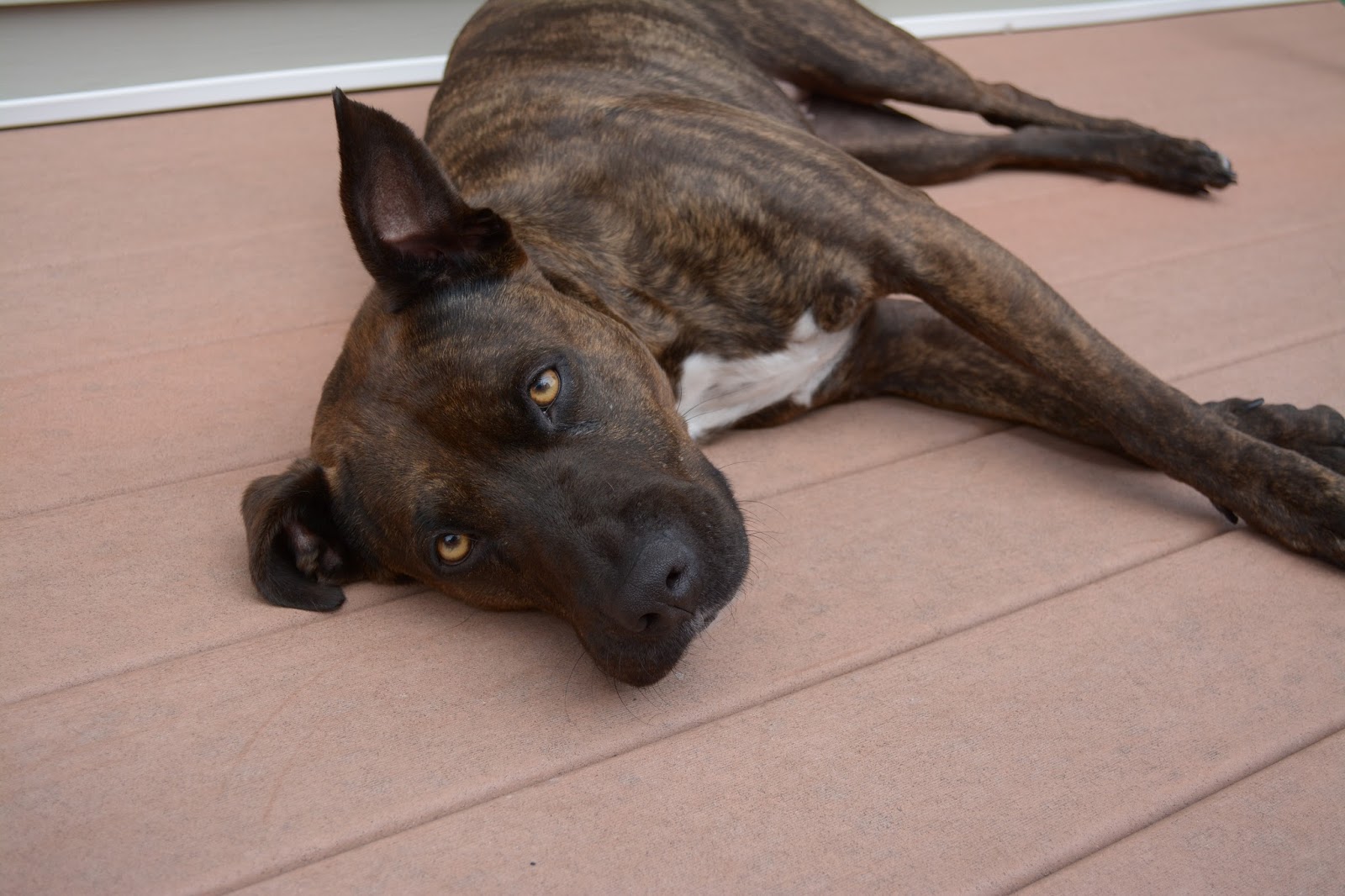
Did you choose the pit mix, Roxie? She's a wonderful dog, and I may be a little biased because she's my very own brat-dog. She's laying down on one side, which is our first indicator that she is pretty comfortable in her environment, but there's more. Look at her eyes compared to Pollo's. Yup- not dilated and you can't see the whites of her eyes. What Pollo is demonstrating perfectly here is what we call a 'whale eye'. There is something bothering him to his left, so he is looking away but doesn't want to look away completely. As I recall, there is a frisbee nearby that he wants, but his buddy Darwin owns it. He had a questionable start to life, so he is learning to accept people and new stimuli in his forever home.
Just to be clear, here is a photo of Roxie looking at something to her left. You can see some of the whites, but this is not a 'whale eye'. Her ears and forehead are relaxed (you can even see wrinkles on her forehead) and her eyes don't have that peeled-open look like Pollo's above. There's more about the rest of her body that tells us she is more curious than worried, but that's another post!

Roxie
 While we are on the subject of eyes, I want to talk about the 'hard stare'. In this picture, Roxie is staring at me because I am taking her picture and annoying her by asking her to stay when there is a toddler running around the deck with a pitcher of water (water is her Kryptonite). The look on her face isn't quite a 'hard stare', but if I didn't know her I would move slowly.

"If he comes over here with that water, I'm gone... for good this time!"
Ok, last one for today. Who here is stressed out, who is excited and who is just hot?
Violet

Jake

Ryder
So, this one is a bit more tricky and that's because we are looking at their tongues- this is a bit more subtle. 

Ryder is the stressed dog here, and aside from the dilated pupils, tight skin on his head and pinned back ears, he has what is called a 'spatulate tongue'. It looks like his tongue is stretched out at the edges as far as it can go. To his credit, it was also a warm evening, but there were lots of people around at a birthday party and he gets excitedly stressed with lots of people. He's a super sweet boy who probably wouldn't hurt a fly unless it threatened his human brother and sisters. If I saw this in class, I would have him get some distance, go for a lap outside the classroom or get him busy with a trick, game or cue. If he can't take treats or listen when he looks like this, he really needs a break. 

That leaves one excited dog and one hot dog. (This should be pretty easy with Jake figured out). 
You got it. Violet is excited and Jake is hot. 
Jake is still at a birthday party, having lots of fun running around with kids but it's August on the eastern shore so it's pretty warm. His tongue is out but the edges are more rounded than flat and his face is a little more relaxed than Ryder's. 
Violet has her tongue out in anticipation of a toy, and because she's happy that Matt is petting her. She loves attention from people. Her tongue is out, but not flattened at all, so she's not terribly warm and she's not stressed at all. 

Good Job! You made it through with all of your digits intact (hopefully). Look closely when you are with your dog this week and see what you learn! 


Resources:
Canine Body Language: A Photographic Guide, by Brenda Aloff.
https://en.wikipedia.org/wiki/Fight-or-flight_response


Thursday, July 16, 2015

Product Review: Kyjen's Paw Hide

There are a ton of dog products out there- toys, leashes, harnesses, collars, bowls, feeders, the list goes on. I have recommended all kinds of products to clients (and friends and family) but I always have to add that "there is the chance it won't work for you/your dog as it has for me/other clients/friends/colleagues." Some dog related products can be pretty pricey and I don't want my clients wasting money on something that doesn't work as planned.
In light of that, I have decided to start adding product reviews to this blog. I have wholesale accounts through a couple of companies so I buy extra items to keep for myself for Roxie to try so I have a good idea of how they work before I go selling or recommending them to clients.

This time, it's the Kyjen Paw Hide:


Using Roxie as our guinea pig, we tried out out for dinner time when it first arrived. To he honest, I'm not sure who was more excited- our son, myself or Roxie.

To fill it is pretty easy; we just split up the 1/2 cup she gets for the meal into the 7 compartments, then place the yellow covers in them. At this point, we only fill some of them and do a couple rounds of searching so she is busy a bit longer. She definitely gets a little frustrated by the empty ones, but does still flip them over just in case, quickly moving on when they are empty. She doesn't try using her paws to flip the whole thing over at this point. There are actually little no-skid pads on the bottom to help prevent this and prevent it from sliding around, but as you can see in the video, it was still moving around a good bit on our kitchen floor that first time. On the carpet it's just fine so that's what we do-we have a toddler so we have crumbs to vacuum up all the time anyway!

I have uploaded videos of the first and fourth time she tried it out and she really seems to like it, despite the fact that it's a relatively simple puzzle. The first time, it took her about two and a half minutes to empty all compartments (with our son's help), in the second video she's down to just under two minutes.


We don't use it every day; we alternate between two food dispensing balls that she rolls around the house, a Kyjen Slo-Bowl (I'll do a review of that one later!), her regular bowl, and this one. It depends on how much time we have, how much our son wants to 'help' her and how much extra dish washing we feel like doing. It is dishwasher safe, but we tend to wash big stuff like this by hand to save room for all the cereal bowls that we go through. It dries pretty quickly after washing, so if we were less lazy it would be do-able for breakfast and dinner for her. It's made of material that is FDA approved for food, and seems to be holding up pretty well to Roxie's use of it. Like I said, she's not using it every meal, probably 2-3 times a week and it's still looking good after 3-4 months. Upon close inspection there are a few scratches but so far so good!

As far as puzzles go, this one is pretty easy for Roxie, but she really seems to like it, though it could just be that she likes food a lot. This is why we sometimes do a couple rounds of searching with it, so she gets more fun and we get more use out of it. I think this is a great starting point for young dogs or unsure dogs to build come confidence skills and burn some mental energy while using natural instincts to search out food.

Here's a link to the Kyjen website, it's also on Amazon and your local dog trainer may also have it available for resale ;)


http://shop.kyjen.com/paw-hide.html

Does your dog have a favorite food toy?

Tuesday, June 2, 2015

Mission Main Street Grant

I'm taking a break from my series on canine body language to tell you about an amazing opportunity I found out about recently. Every year, Chase Bank gives a bunch of money in the form of grants to small businesses. This year, they are giving 20 small businesses $100,000 each and I would really love for Smart Pups to be one of the lucky recipients.
The way it works is any for-profit small business that has 100 employees or less that has been in business for at least two years. There are a few more rules, feel free to check them out here. Eligible businesses submit an application, complete with five essay questions:
  1. Tell us about your business and what makes it unique. Please provide a general description of your product, customers, competitive landscape and overall performance.
  2. What inspired you to become an entrepreneur? Describe both your greatest achievements and biggest challenges.
  3. How is your business involved with the community you serve? Examples include: giving back to the community, sourcing locally and/or contributing to economic development via hiring.
  4. What would a $100,000 grant mean to your business and how will you utilize the funds? Please be as specific as possible.
  5. What are your short-term (1-2 years) and long-term growth plans for the business? How will this grant contribute to your plan?
Those have to be answered in 200 words or less; let me tell you that was tough! Apparently I tend to use lots of words...

After submitting that, the small business isn't done- now they need to get 250 votes to get to the next stage of voting. The businesses that get 250 votes will then be reviewed by a panel selected by Chase, to find the twenty businesses most deserving of the grants. Here's a link to this year's panelists.
They choose the winners and notify them and the winners get to build their businesses and help their community. Oh yeah, they are all about how these winners will help their community. Not to brag or anything, but a dog trainer who understands dogs, people, science, behavior and communication is a perfect choice to help the community in which they live.
Before you go voting or not voting, I just wanted to share with you my dream for Smart Pups and how I would use this grant if I were to win.
Though I have faced challenges along the way in the form of difficult dogs and people, the biggest challenge I have face in the past 5 years has been finding a good, affordable facility for group classes. When Smart Pups was located in New York, I was lucky enough to build a friendship with another trainer who was generous enough to share her training facility when she wasn't using it. Here in Salisbury, I am currently renting outdoor space in an equestrian show ring, which works well. The downside is that it's outside so if it rains or it winter, I can't have class. The ring is not completely closed in and is outdoors so it's not fit for puppy class. What I plan to (someday) do it build a training facility, where there is indoor heated and cooled space as well as outdoor space for classes. With the indoor space, I won't have to watch the weather constantly and classes will have a more definite start and end date, making it easier to plan classes far in advance. With secure indoor and outdoor space, my clients will have the comfort of knowing their dog is safe and the environment is ideal for learning- no unexpected passers-by and comfort in all seasons. With a facility offering storage and more space, I could also offer more specialty classes like reactive dog class, puppy class and agility training. By offering more services, I could reach more of the dogs and their humans in my community and help them all to learn to be more polite and responsible when out and about. If more people understand their dogs, and more dogs are getting training and good socialization opportunities, the more well-behaved they are. The thing is, dog training isn't exactly the most lucrative career, unless you can get a T.V. show and work with celebrities. I don't see that in my future, so to build all this will mean saving up for a while and even then, taking out a loan to build. Not that I mind that- that's my plan and what I will do no matter what, but the opportunity to do it all so much sooner that I thought possible would be amazing.
So, if you have a minute, please go to https://www.missionmainstreetgrants.com/vote  and type in Smart Pups in the box, then click on vote. It does make you log in with facebook, because they want to verify you are a real person, but it all seems pretty kosher to me :)

That's it for this week- I'm going to finish up the next in the canine body language series and get it up (hopefully) within the next couple days.

Thanks and please vote for Smart Pups!